Saturday, June 26, 2010

Artist Trading Card Workshop


The  advanced Brush Strokes watercolor class just finished a two part workshop focusing on Artist Trading Cards.   Scattered throughout this blog are photos taken during the workshop. 


Artist Trading Cards (or ATCs) are miniature works of art about the same size as modern baseball cards, or 2 ½ X 3 ½ inches (63 mm X 89 mm), small enough to fit inside standard card-collector pockets, sleeves or sheets. The ATC movement developed out of the mail art movement and has its origins in Switzerland. Cards are produced in various media, including dry media (pencils, pens, markers, etc.), wet media (watercolor, acrylic paints, etc.), paper media (in the form of collage, papercuts, found objects, etc.). The cards are usually traded or exchanged rather than sold.

History
Artist trading cards were used throughout Europe and America as art training tools. Artists would trade the cards between themselves to study each others’ techniques and explore new art movements. The cards paid a particularly important role in the Impressionists art movement. The Impressionists utilized both sides of their artist trading cards, art on one side and a kind of brief resume on the other. The Impressionists were the first known artists to use the cards in trade for anything other than more art. Impressionists often traded the cards with art collectors in exchange for room, board, and art supplies.


M. Vänçi Stirnemann is credited in many circles with popularizing the modern artist trading card in 1996, holding trading sessions in Zurich, Switzerland. This resurgence of interest of Artists trading cards has spawned the popular ACEO (art cards editions and originals) movement. Many people consider art trading cards and ACEO cards to be one and the same. Others feel they are decidedly different pieces of art.

Clubs, trading sessions, and online mailart communities have largely replaced the original concept of trading the cards during individual encounters, and many ATC workshops end with a trading session.

Our class session ended with a trading session; and when we are rich and famous artists, we can proudly say that we own a work of art by a famous artist. 

My blog next week will show some of the individual ATCs and give instructions for creating ATCs of your own.

Happy Painting!
Karen

Saturday, June 19, 2010

Archway to Spring


Archway to Spring
Watercolor 11" x 15" Mats to 16" x 20"


The watercolor above, Archway to Spring, is an excellent example of the use of various types of masking and resists.  Liquid masking fluid was used to mask the bars on the window frame, highlights on the rims of the flowerpots, and areas for flowers in the mass of greenery on the left.

A "resist" was used to apply color and texture also.  The resist I used was oil pastels; however, good old Crayola crayons could have been used as well.  . The oil in the pastels acts as a resist when the watercolor paint is applied. Roughly dash in leaf shapes using light green for the tallest bush and darker green for the in the foreground. Drag pale yellow streaks across the stonework under the window. Put in some orange on the bricks and the flowerpots. Put in some light tones of gray or black on the stonework under the window.

Watercolor Tip
Do not paint all areas of the paper - let the painting fade into “nothingness” with little detail on the edges.

Happy Painting!

Saturday, June 12, 2010

Tickets, Anyone?

Tickets, Anyone?
Watercolor 11" x 15" Mats to 16" x 20"

The watercolor above, Tickets, Anyone?, is a corner Broadway ticket booth in New York City during the early hours of the morning when everyone is still in bed.  :)    The early morning light is filtering through the tall buildings from the right side of the painting.  Of course, one could put people in the painting, but I prefer to let the play of light on the architectural structures be the focal point.  My opinion is that people in the painting would detract from the painting.

Watercolor Tip:
Let the white of the paper provide the highlists and illuminate all the other colors and tones in the painting.    Leave the areas in full sunlight completely white such as the dome, the front part of the sidewalk and part of the right side of the ticket booth.  Lighter areas of filtered sunlight are on the left side of the painting including the top of the building on the upper left.  The right side of the painting is in shadow shielded by one of the tall building on the right.  Keep the colors on the right darker. 

The ticket booth is the focal point and all the surrounding buildings are vague and blurry.....my favorite style of paintings.

Try a street scene and remember - just because there is a building or object in a photo or on location, one does not have to paint it. As an artist you have "artistic license" and can interpret a scene in anyway you chose!

Happy Painting!

Saturday, June 5, 2010

Gourd Harvest

Gourd Harvest
Watercolor 11" x 15" Mats to 16" x 20"

The watercolor above, Gourd Harvest, was an interesting still life to paint - with both challenging areas and easy ones.    

The Challenging Areas:
Painting the water-filled pitcher was the challenge.    Actually, the water was not painted at all, only the reflection of the items in the water.  The glass pitcher was painted by only painting the shadows and highlights. 

The Easy Areas:
Painting the gourds were fun.  One of the reasons that I love watercolor is the ability to blend colors seamlessly.  The gourds were based painted in the lightest shade of the gourd, then washes of darker colors were applied and allow to dry. 

Watercolor Tip:
Don't forget to paint the reflections/shadows of the gourds and pitcher.

Happy Painting!

Saturday, May 29, 2010

Bamboo Triptych

Bamboo Triptych 
Watercolor
(3) Panels each panel 7-1/2" x 17-1/2"
Framed with bamboo and jute

I enjoy trying different types of paintings and this one is different from most of my work.  However, it was fun to do and turned out to be an interesting painting.

A triptych is a series of three paintings which together make a whole.

Watercolor tip:
  • Sketch in the bamboo with little detail on three sheets of watercolor paper or one large sheet in a continuous stalk. 
  • Begin painting the large bamboo stalk using a large flat brush.  Paint a separate wash for each section of the bamboo stalks.  To keep the painting consistent, work on all three (3) panels simultaneously.
  •  After the painting has dried, tear the edges of the painting around all edges. 
  •  To "frame" the painting, use jute and bamboo stalks.

Step outside of your "comfort zone" and painting something different---you'll enjoy it and be pleased with your results.

Happy Painting!

Saturday, May 22, 2010

Southern Summer

Southern Summer
Watercolor 11" x 15" Mats to 16" x 20"

My watercolor painting above, Southern Summer, is one of my favorites and is in my personal gallery.  This house and garden are typical of a Southern home complete with a white fence, garden gate, blooming flowers, a balcony above the door and a warm Southern welcome!

Watercolor Tip
The fence and gate as well as the balcony rails were masked in using liquid masking fluid.  Although this is time consuming (and I am an impatient painter) masking was well worth the time and effort in this painting.  The flowers and greenery were painted before the masking was removed.  After removing the masking a few flowers and greenery were sponged on top of the rails depicting those flowers growing through the fence. Although I used masking fluid for the rails,  narrow painter's tape could have been used as well. 

If you are often like me and eager to paint rather than mask and wait for it to dry, consider the finished painting.  Many times, masking is worth the effort. 

Happy Painting!

Saturday, May 15, 2010

Sow What?


Sow What?
Watercolor 11" x 15" Mats to 16" x 20"

Today's advanced watercolor class concluded their study of  painting a still life.   The painting above, Sow What?  is my interpretation of the still life from the objects set up.  There are many possibilities of subjects to paint in a still life, especially following my favorite definition -- "anything that does not move or is dead."  Because of the many possibilities, selection of a subject was difficult.  I finally decided since it was Spring and time for gardening that gardening tools would be a fun subject. The photo below is the set up for the still life.

Once I had the items setup, the fun part for the students began.  Everyone sat at a different angle on the subject, so that in itself would make each painting unique.  Also, each student had to select "how" to execute the painting - how big, how small, how to position on the page, background, etc.    My favorite part as a teacher was to see how each student interpreted the subjects in their own special way and how the painting was executed using the skills learned in class.


Watercolor Tip
When painting any subject, each artist should put their own special style on the painting.....that is what makes a painting of the same subject unique.  Don't be afraid to look at things from a different angle, use a different technique, try a new color!  Make the painting your own and most of all - have fun!

Happy Painting!


Saturday, May 8, 2010

Unusual Still Life


Sea Wall
Watercolor 8.5" x 11" Matted to 12" x 16"

Our unit of study this session in my advanced watercolor classes is still life paintings.  When one thinks of a still life, a bowl of fruit is usually the subject one thinks about first - or perhaps a vase of flowers.  Based on the definition of a still life from the Tate Museum Glossary, the subject of a still life is "anything that does not move or is dead."  (I like this definition.)  :)  This definition opens up a whole new world of what can be considered a still life.    Traditionally, some objects in a still life were likely to have been selected for their symbolic meaning, but this symbolism eludes most modern day art gallery visitors.    A still life is a work of art of inanimate subjects, typically commonplace objects. 

My watercolor above, Sea Wall, is one of my favorites-- very simple still life of a sea wall with a chain and rope.

Watercolor tip:
The background of this painting used a technique that I found interesting.  The wet watercolor paint was dusted with flour in spots to add texture to the sea wall and give the illusion of age and pitting from the sea.  The paint and flour were allowed to dry and then dusted off creating some interesting texture.

Find something that "does not move or is dead" and paint yourself a still life!    You'll have fun and smile when you think of the definition!

Happy Painting!

Saturday, May 1, 2010

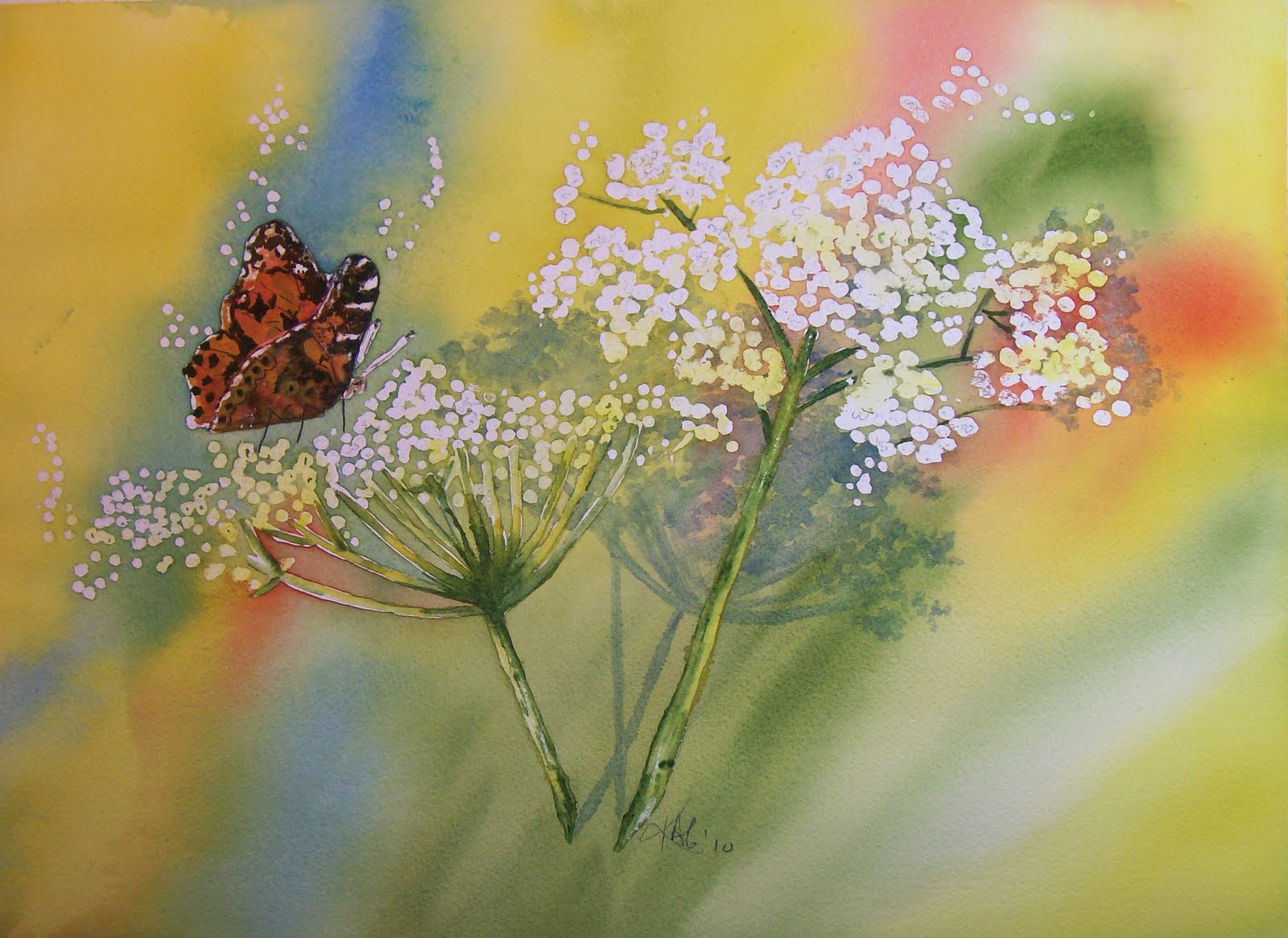
Flutter By


Flutter By
Watercolor 11" x 15" Mats to 16" x 20"

Wildflowers are starting to bloom and nature seems to be awakening!  Butterflies and birds are returning to my flower garden.  I like wild flowers;  and in my painting above, Flutter By,  I have painted Queen Anne's Lace with a butterfly sipping the sweet nectar.    One of my fondest memories of this particular wildflower was at a nature center near our home.   We took our son to the Spring Festival at the nature center when he was around 6 years old.   At  one of the exhibits they were preparing "natural" foods.  They had dipped Queen Anne's Lace in a pancake batter and deep fried it....probably not too healthy, but it was "natural."  We enjoyed watching the faces of the people who sampled the delicious "batter cakes" and then found out they were eating wild flowers.   Yum!  I figure if you dip something in batter and fry it - what is there not to like!  :)   My son thought this was great fun!

Watercolor Tip
I masked the flowers and butterfly using a liquid masking fluid so that I could paint the background easily.  I used a very wet wash of several different colors and allowed them to blend and merge as they dried.  If the colors did not blend naturally, I sprayed a little water on the paper to help with the blending.  Use a concentrated wash of color so that as it dries, it will stay bright.

Now, get out and enjoy Spring, sketch something special, and pick up that brush!  Pick a few wildflowers while you are at it.........is that batter cakes I smell!  :)

Happy Painting!


Flutter By
Watercolor 11" x 15" Mats to 16" x 20"

Many varities of wild flowers are starting to bloom and the painting above is "Queen Anne's Lace" with a butterfly enjoying the nectar.    The blurred background makes the butterfly and flowers stand out in stark contrast to the mulitcolored colored background.

Watercolor Tip:
The flowers and butterfly were masked out with liquid masking fluid to allow me to paint the background in a very wet wash of several diferent colors that blended and merged as the backgroun dried.   The flower shadows were painted with a wash of blue onto the dry background.  The shadows were painted before the masking was removed from the flowers.

Enjoy the many colors and sights of Spring!  Find something simple in nature, sketch a painting and pick up that brush!

Happy Painting!